
– PHARMACIST FINANCE WEEKLY –
PHARMACIST
FINANCE
WEEKLY
The Essential Newsletter for Pharmacy Professionals|Your weekly dose of business insights, market intelligence, and career opportunities
Issue #4 | WEEK OF JULY 6th, 2026
When Should You Claim Social Security?
The break-even math — and why the math is only part of the answer.
Sources: SSA.gov • Charles Schwab Retirement Guide (2026) • AARP Social Security FAQ • CNBC Retirement (May 2026)
The Question Every Near-Retirement Pharmacist Asks
You’ve spent 30 years on your feet, managing a pharmacy, counseling patients, and keeping up with everything that profession demands. Now retirement is in sight — and suddenly everyone has an opinion about when you should claim Social Security.
Your neighbor says take it at 62. Your brother-in-law says wait until 70. A social media influencer says take it early and invest the difference. Your HR department hands you a pamphlet and wishes you luck.
The truth is, there is no single right answer. But there is a right framework for thinking about it — and that’s what this article is about.
The Numbers at a Glance
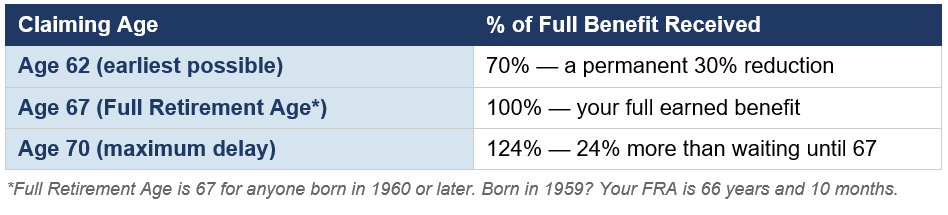
The Core Concept: Break-Even Analysis
Social Security is roughly actuarially adjusted so that lifetime benefits are broadly comparable across claiming ages for an average life expectancy. Claim early, get smaller checks for longer. Claim late, get larger checks for fewer years.
The “break-even age” is the point at which delaying starts to pay off in total cumulative dollars. Here’s what that looks like for a hypothetical pharmacist with a $2,000/month benefit at Full Retirement Age:
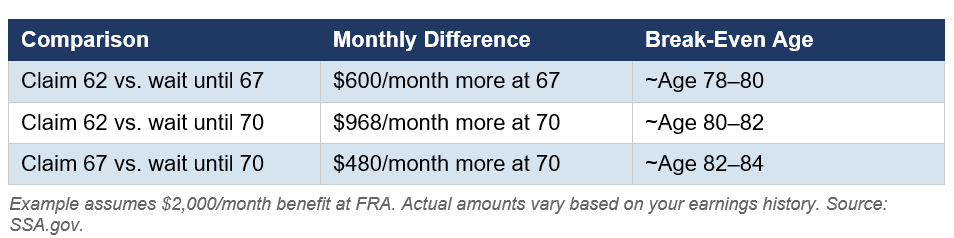
The key takeaway:
If you live past your early 80s, delaying often results in higher cumulative lifetime benefits. The challenge is that none of us knows exactly how long we’ll live — and that’s why break-even math alone isn’t enough
Beyond the Math: What Actually Drives the Decision
Break-even analysis is actually the wrong framing for most people. The real question isn’t “when do I get the most total dollars?” It’s “what does this income need to do for me, and when do I need it?”
Here are the factors that matter most:
1. Your health and family history.
If longevity runs in your family and you’re in good health, delaying makes the math work in your favor. If you have significant health concerns, earlier claiming may be the right call.
2. Whether you’re still working.
If you claim before your Full Retirement Age and continue working, Social Security will temporarily withhold $1 in benefits for every $2 you earn above $24,480 (2026 limit). That withholding is eventually recalculated back into your benefit — but it creates cash flow complexity.
3. Your spouse’s situation.
If you’re married, the higher earner’s benefit becomes the survivor benefit when one spouse passes. A higher earner delaying to 70 can meaningfully protect a surviving spouse’s income for decades.
4. The 8% annual increase.
Every year you delay from FRA to age 70, your benefit grows by 8% — an inflation-adjusted increase in guaranteed lifetime income that is difficult to match consistently in the market, particularly in retirement when portfolios tend to be more conservative.
5. Tax implications.
Up to 85% of your Social Security benefit may be taxable depending on your combined income. Delaying benefits creates a window — often ages 62–70 — that can be used strategically for Roth IRA conversions before Social Security income pushes your AGI higher.
6. Medicare enrollment is separate.
If you delay Social Security beyond age 65, remember that Medicare enrollment rules are separate. You will generally still need to sign up for Medicare at 65 to avoid late enrollment penalties, regardless of when you claim Social Security.
What This Means for Pharmacists Specifically
Pharmacists face a particular version of this decision. Most have worked long careers with strong, consistent incomes — which means their Social Security benefit tends to be substantial. A 30% permanent reduction at 62 isn’t a small number when your benefit is near the upper end of the scale.
Many pharmacists also retire with meaningful 401(k) balances and, in some cases, a pension or profit-sharing component. That creates an important opportunity: if you can cover living expenses through retirement savings in your early 60s, you can let Social Security grow — collecting the 8% per year delayed credit — before turning it on at 70.
The flip side is also worth considering. If you claim Social Security earlier, your portfolio doesn’t have to carry the full weight of your income needs right away. With a guaranteed check coming in each month, your investments can stay in growth-oriented positions longer — and ride out market volatility without forcing you to sell at the wrong time. For some retirees, that breathing room is worth more than the higher benefit they’d get by waiting.
Your One Action Step This Week
Create your “my Social Security” account at ssa.gov/myaccount. In about five minutes you can see your personalized benefit estimate at 62, 67, and 70 — based on your actual earnings history, not generic examples. That’s the starting point for every conversation about when to claim.
Once you have those numbers, you’re ready to have a real conversation — one that factors in your health, your spouse, your retirement income sources, and your tax situation. That’s exactly the kind of conversation we have with clients every day.
Sources
Social Security Administration — Retirement Age and Benefit Reduction
Charles Schwab — Guide on Taking Social Security: 62 vs. 67 vs. 70 (2026)
AARP — What Is the Break-Even Age for Social Security? (December 2025)
CNBC — Social Security Claims at 62 Get Social Media Buzz — Experts Urge Caution (May 2026)
STAY UP TO DATE –
Share our Newsletter!
Forward to Colleagues: Help grow our community of financially-savvy pharmacists