
– PHARMACIST FINANCE WEEKLY –
PHARMACIST
FINANCE
WEEKLY
The Essential Newsletter for Pharmacy Professionals|Your weekly dose of business insights, market intelligence, and career opportunities
Issue #6 | WEEK OF JULY 21, 2026
Spousal and Survivor Benefits: What Couples Need to Know
Two benefits. Different rules. And a coordinated strategy that can add up to tens of thousands of dollars over a lifetime.
Sources: SSA.gov • Vanguard Retirement Research • AARP • The Motley Fool
Two Benefits Most Couples Treat as One
When couples think about Social Security, they usually think about their own individual benefits — the check each person earned through their own work history. What often gets overlooked is that Social Security also provides two additional benefits specifically designed for married couples: the spousal benefit and the survivor benefit.
These aren’t the same thing. They have different eligibility rules, different maximum amounts, and different claiming strategies. Understanding how these benefits work together is one of the most important parts of retirement income planning for married couples.
Part One: The Spousal Benefit
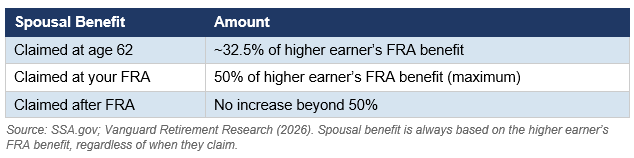
The spousal benefit allows a lower-earning spouse to receive a benefit based on the higher earner’s record, rather than their own. If your own retirement benefit is less than the maximum spousal benefit available, Social Security may add a spousal supplement that brings your total benefit up to as much as 50% of your spouse’s Full Retirement Age benefit.
To make this concrete: if the higher earner’s FRA benefit is $4,000 per month, the maximum spousal benefit would be $2,000 per month at the lower earner’s FRA — regardless of whether the higher earner delayed to 70 and now receives a larger check. The spousal benefit is always anchored to the FRA amount, not the delayed amount.
A few rules that catch people off guard:
1. It’s based on your spouse’s FRA benefit — not their delayed benefit.
Even if your spouse waits until 70 to claim and receives a larger check, your spousal benefit is still calculated from what they would have received at their Full Retirement Age. Delaying does not increase the spousal benefit.
2. Claiming early permanently reduces it.
If you claim the spousal benefit before your own FRA, it is reduced. The maximum spousal benefit — 50% of your spouse’s FRA benefit — is only available if you claim at your own FRA. Claiming at 62 reduces it to approximately 32.5%.
3. Delaying past FRA provides no additional benefit.
Unlike your own retirement benefit, which grows 8% per year between FRA and age 70, the spousal benefit does not increase if you delay past your FRA. There is no advantage to waiting beyond that point for the spousal benefit specifically.
4. Your spouse must be receiving their benefit first.
You generally cannot claim a spousal benefit until your spouse has filed for their own Social Security. If your higher-earning spouse is delaying to 70, you will need to wait as well — or claim your own smaller benefit in the meantime.
5. Deemed filing applies.
Deemed filing means that when you apply for Social Security, you are automatically applying for every benefit you are eligible for at that time — and SSA pays you the higher amount. For retirement and spousal benefits, you generally cannot choose one benefit while allowing the other to continue growing separately. For most people born after January 1, 1954, this means the lower-earning spouse cannot claim only a spousal benefit while waiting for their own benefit to increase.
Part Two: The Survivor Benefit
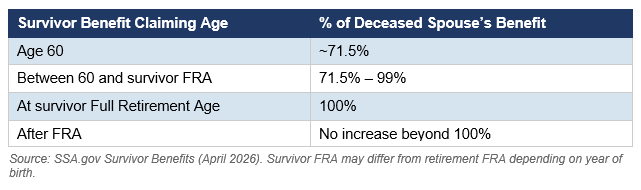
The survivor benefit is separate from — and in most cases larger than — the spousal benefit. When a spouse passes away, the surviving spouse becomes eligible to receive up to 100% of the deceased spouse’s benefit, rather than the 50% maximum available while both spouses are living.
This is one of the most financially significant transitions a surviving spouse will face, and the rules are meaningfully different from the spousal benefit rules:
Can be claimed as early as age 60.
Unlike regular retirement benefits, which can’t begin before 62, survivor benefits can start at age 60 — or age 50 if the surviving spouse is disabled. Claiming early reduces the benefit, with the minimum being about 71.5% at age 60.
Delayed retirement credits are included.
If the higher-earning spouse delayed claiming and accumulated delayed retirement credits, those credits are factored into the survivor benefit. A spouse who waited until 70 passes along a larger check to their surviving partner. The reverse is also true — if the higher earner claimed benefits early, that reduction can carry through to the survivor benefit as well.
Deemed filing does not apply.
This is a critical difference from spousal benefits. A surviving spouse can claim survivor benefits at 60 and delay their own retirement benefit until 70 — or vice versa. This flexibility allows for a switching strategy that can increase lifetime income. Note that survivor Full Retirement Age is not always the same as retirement FRA and can vary by birth year — this affects the reduction schedule for early claiming and is worth verifying with SSA directly.
The Survivor Switch Strategy:
Because deemed filing doesn’t apply to survivor benefits, a surviving spouse can file for a reduced survivor benefit as early as age 60, while allowing their own retirement benefit to grow 8% per year until age 70. At 70, they switch to their own larger benefit if it’s higher. This strategy can materially increase lifetime income and is one of the most valuable — and least understood — tools available to surviving spouses.
Remarriage rules apply. Remarrying before age 60 generally ends eligibility for survivor benefits based on the prior spouse’s record. Remarrying at or after age 60 does not affect eligibility.
The Coordinated Strategy Most Couples Should Consider
For couples with a meaningful gap in earnings histories — which describes many pharmacist households — a coordinated claiming strategy can make a significant difference in lifetime income.
For many couples, especially when one spouse has significantly higher lifetime earnings, the higher earner delaying until age 70 can materially increase both household income and the future survivor benefit. For many households, this strategy can accomplish three important goals simultaneously:
- Maximizes the higher earner’s own monthly benefit.
- Maximizes the survivor benefit the lower-earning spouse would receive if the higher earner passes away first.
- Provides the most inflation protection over a long retirement, since the larger benefit grows with cost-of-living adjustments over time.
Meanwhile, the lower-earning spouse has options. They can claim their own benefit early while the higher earner delays, and once the higher earner files, Social Security will determine whether an additional spousal supplement applies. Survivor benefits retain more flexibility and can often be coordinated separately, as described above.
One important note for those still working: if you claim any Social Security benefit before your Full Retirement Age and continue earning income, the earnings test will temporarily reduce your benefits if your earnings exceed the annual SSA limit. For 2026, that limit is $24,480. If you earn more than that, the SSA withholds $1 in benefits for every $2 you earn over the limit — a critical threshold for pharmacists picking up high-hourly-rate shifts in semi-retirement.
For dual-income couples where both spouses have substantial earnings records, the analysis is more nuanced. Each situation is different, and the right strategy depends on both spouses’ benefit amounts, ages, health, and other income sources.
A Note on Divorced Spouses
The spousal and survivor benefit rules extend to divorced spouses under certain conditions. If you were married for at least ten years, are currently unmarried, and are at least age 62, you may be eligible for a spousal benefit based on your ex-spouse’s earnings record — provided your ex-spouse is also at least age 62 — without affecting what they receive. If the divorce has been final for at least two years, you may be able to claim even if your ex-spouse has not yet filed for their own benefits. If your ex-spouse has passed away, survivor benefit rules may apply as well.
These rules are worth knowing. They come up more often than people expect, particularly for those who had long first marriages before a later divorce.
Your One Action Step This Week
If you’re married, sit down together and pull up both of your “my Social Security” statements at ssa.gov/myaccount. Look at each person’s projected benefit at 62, 67, and 70. Then ask: what is 50% of the higher earner’s FRA benefit? Is that more or less than the lower earner’s own projected benefit? That comparison is the starting point for a coordinated claiming conversation.
Spousal and survivor benefit planning is one of the areas where working with a financial advisor adds real, measurable value. The rules are specific, the tradeoffs are significant, and many claiming decisions are difficult or costly to reverse once made. If you’d like to model how these benefits would work in your specific situation, that’s a conversation worth having before you file for anything.
Sources
Social Security Administration — Survivor Benefits: What You Could Get (April 2026)
Vanguard — Social Security Strategies for Married Couples
AARP — Social Security When a Spouse Dies: A Guide to Survivor Benefits
Fidelity — Social Security Tips for Couples
This article is for educational purposes only and does not constitute personalized financial, tax, or legal advice. Social Security rules are complex and individual circumstances vary. Consult a qualified financial advisor before making claiming decisions. Adam Conway is a Registered Principal. Securities offered through Cambridge Investment Research, Inc., a Broker/Dealer, Member FINRA/SIPC. Investment Advisor Representative, Cambridge Investment Research Advisors, Inc., a Registered Investment Advisor. Cambridge and Conway Financial are not affiliated.
Share our Newsletter!
Forward to Colleagues: Help grow our community of financially-savvy pharmacists