
– PHARMACIST FINANCE WEEKLY –
PHARMACIST
FINANCE
WEEKLY
The Essential Newsletter for Pharmacy Professionals|Your weekly dose of business insights, market intelligence, and career opportunities
Issue #7 | WEEK OF JULY 28, 2026
Working While Collecting Social Security Before Full Retirement Age
The earnings test is widely misunderstood — and for pharmacists picking up shifts in semi-retirement, the numbers matter.
Sources: SSA.gov • Kiplinger • AARP • Covisum
Semi-Retirement Is Common in Pharmacy
Pharmacy is a profession with options. Many pharmacists approaching retirement don’t stop working entirely at 62 or 65 — they step back. They pick up extra shifts, move to part-time hours, consult, or take on a reduced schedule that keeps them engaged without the full demands of a staff position.
That flexibility is genuinely valuable. But it creates a planning question that surprises more people than it should: if you claim Social Security before your Full Retirement Age and continue earning income from work, the government may withhold a portion of your benefits.
This is called the earnings test. It’s not a penalty and it’s not permanent — but it can significantly affect your monthly cash flow in the years before your Full Retirement Age (FRA) if you’re not expecting it.
How the Earnings Test Works
The earnings test applies only if you claim Social Security before your Full Retirement Age and earn income from work above certain annual thresholds. There are two different limits depending on where you are relative to your FRA:
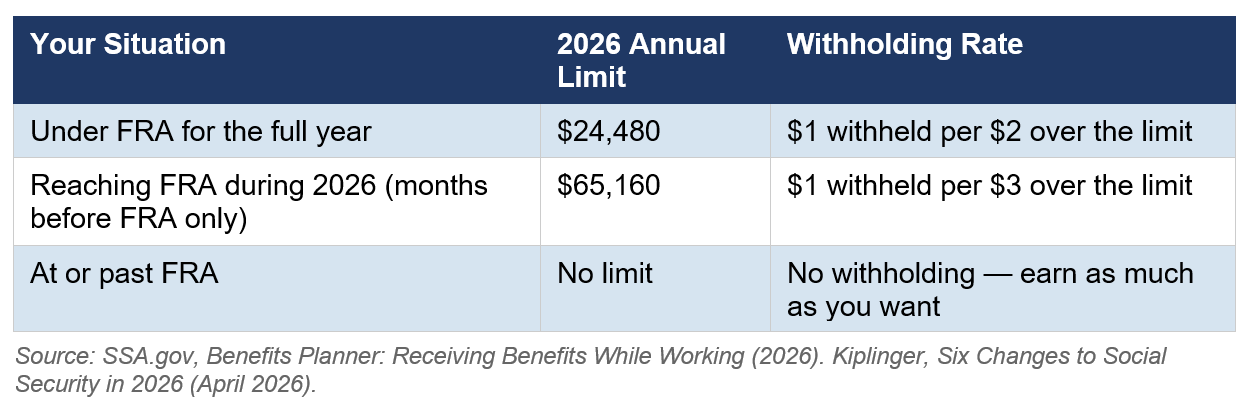
The test disappears entirely the month you reach Full Retirement Age. From that point forward, you can earn any amount from work without affecting your Social Security benefit.
What Counts as Earned Income — and What Doesn’t
The earnings test applies only to income earned from work. Not all income counts, and this distinction matters for retirees with multiple income sources.
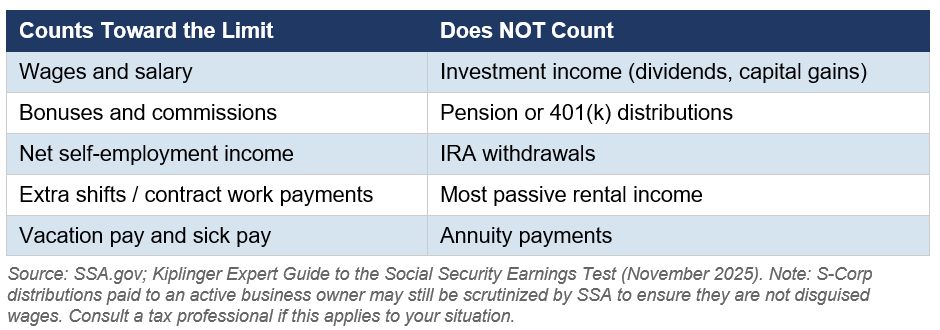
For pharmacists, this is an important distinction. If you’re drawing from a 401(k), receiving pension income, or earning investment returns, none of that counts toward the earnings test limit. Only active work income — including extra shifts and contract pharmacy work — applies.
A Real-World Example: Meet Linda
Linda is 63, just retired from her staff pharmacist position, and decides to claim Social Security early. Her benefit is $2,500 per month ($30,000 per year). She also picks up extra shifts on weekends — about 10 hours a week at $65 per hour, adding up to roughly $33,800 per year in earned income.
Here’s what happens:
- The 2026 earnings limit is $24,480.
- Linda earns $33,800 — that’s $9,320 over the limit ($33,800 − $24,480 = $9,320).
- SSA needs to withhold $1 for every $2 over the limit — $4,660 in total withholding ($9,320 ÷ 2 = $4,660).
- Because SSA withholds entire monthly checks, Linda’s first two checks are withheld completely ($2,500 × 2 = $5,000). The $340 over-withheld ($5,000 − $4,660 = $340) is refunded to her the following year.
- Instead of $30,000 in Social Security for the year, Linda effectively receives $25,340 ($30,000 − $4,660 = $25,340) — but she experiences it as two missing checks at the start of the year, not smaller payments each month.
The good news:
When Linda reaches her Full Retirement Age of 67, SSA recalculates her benefit by reducing her early-claiming penalty to account for the months her checks were withheld. In practical terms, if Linda had 12 months of checks withheld over several years, SSA recalculates her benefit as if she had claimed at 63 rather than 62 — giving her a permanently higher monthly check going forward.
The simple takeaway: at just 10 hours a week, Linda loses nearly $400 per month in Social Security she was counting on — and experiences it as two missing checks at the start of the year. That’s a number worth knowing before you accept the first shift.
The Pharmacist Math: Why This Catches People Off Guard
The $24,480 annual limit sounds substantial until you consider what pharmacy work actually pays. At typical part-time pharmacist rates, that threshold can be reached faster than most people expect.
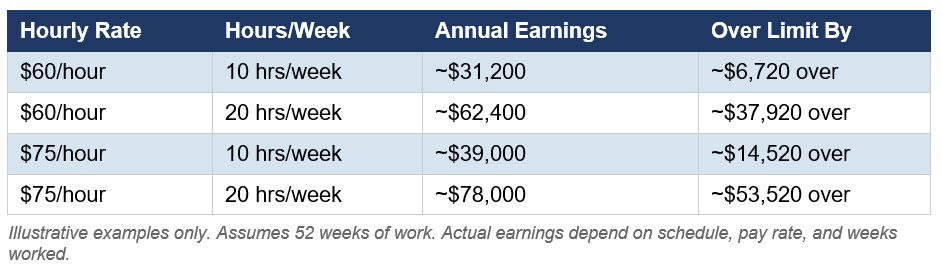
Even working just one or two shifts per week at pharmacist rates puts many semi-retired pharmacists above the threshold. The withholding is $1 for every $2 over the limit — so someone earning $31,200 while collecting Social Security would have approximately $3,360 in annual benefits withheld.
The Good News: Withheld Benefits Are Not Lost
This is the most commonly misunderstood aspect of the earnings test. Benefits withheld before Full Retirement Age are not permanently gone. When you reach FRA, the SSA recalculates your benefit upward to give you credit for the months your benefit was reduced or withheld entirely.
In practical terms, this means the earnings test is more of a deferral than a penalty. You receive less now and more later. For retirees with average or longer-than-average life expectancies, the long-term impact may be smaller than it initially appears.
That said, the recalculation does not always fully offset the short-term reduction — particularly if benefits were withheld for multiple years. If managing monthly cash flow in your early retirement years matters, the earnings test is a real planning consideration even if it isn’t a permanent loss.
The First-Year Monthly Rule
There is one important exception to the annual earnings test that benefits people who retire mid-year. In your first year of receiving Social Security benefits, a special monthly earnings test applies.
Under this rule, if your monthly earnings in any given month fall below the monthly equivalent of the annual limit ($2,040 in 2026), you can receive your full Social Security benefit for that month — regardless of how much you earned earlier in the year. This is particularly useful for pharmacists who worked a full salary for the first part of the year and then reduced hours or retired completely partway through.
This rule only applies in the first year of receiving benefits. After that, the annual limit governs.
Three Strategies Worth Considering
1. Wait until your Full Retirement Age to claim.
If you plan to continue working at meaningful hours after 62, one straightforward approach is to delay claiming Social Security until your Full Retirement Age. At that point the earnings test disappears entirely and you can earn any amount without affecting your benefit — while also receiving a larger monthly check for waiting.
2. Track your earnings carefully.
If you do claim before FRA and continue working, keep a running total of your earned income for the year. Knowing where you stand relative to the $24,480 limit allows you to make informed decisions about whether to accept additional shifts and what the cash flow impact will be.
3. Use the year you reach Full Retirement Age strategically.
In the year you reach FRA, the limit jumps to $65,160 and the withholding rate drops to $1 per $3 over the limit. For many pharmacists, this window offers considerably more flexibility to work without meaningfully affecting their benefit — and the test ends entirely the month FRA is reached.
Your One Action Step This Week
If you are within five years of retirement and considering part-time or extra shift pharmacy work, estimate your likely annual earned income and compare it to the $24,480 threshold. If you expect to exceed it, factor the earnings test into your claiming timeline. A conversation with your financial advisor before you file for Social Security — not after — can prevent a cash flow surprise in year one.
The earnings test is one of the most practical Social Security topics for pharmacists in semi-retirement — and one of the most frequently overlooked in retirement planning conversations. If your situation involves any combination of early claiming and continued work, it’s worth modeling the numbers before you commit to a claiming date.
Sources
Social Security Administration — Benefits Planner: Receiving Benefits While Working (2026)
Kiplinger — Six Changes to Social Security in 2026 (April 2026)
Kiplinger — Expert Guide to the Social Security Earnings Test (November 2025)
AARP — Can You Work and Still Collect Social Security?
This article is for educational purposes only and does not constitute personalized financial, tax, or legal advice. Social Security rules are complex and individual circumstances vary. Consult a qualified financial advisor before making claiming or work decisions. Adam Conway is a Registered Principal. Securities offered through Cambridge Investment Research, Inc., a Broker/Dealer, Member FINRA/SIPC. Investment Advisor Representative, Cambridge Investment Research Advisors, Inc., a Registered Investment Advisor. Cambridge and Conway Financial are not affiliated.
Share our Newsletter!
Forward to Colleagues: Help grow our community of financially-savvy pharmacists