
– PHARMACIST FINANCE WEEKLY –
PHARMACIST
FINANCE
WEEKLY
The Essential Newsletter for Pharmacy Professionals|Your weekly dose of business insights, market intelligence, and career opportunities
Issue #5 | WEEK OF JULY 13th, 2026
How Your Salary History Affects Your Social Security Benefit
The formula is more complex than most people realize — and for high earners, the details matter.
Sources: SSA.gov • Congressional Research Service (R46658, 2026) • The Motley Fool • Bipartisan Policy Center
Most People Assume Social Security Is Simple
Pay in your whole career, collect a check when you retire. How complicated can it be?
Quite complicated, actually — and the details matter more than most people expect. The size of your Social Security benefit is determined by a specific formula that looks at your earnings history, indexes past earnings to national wage growth, applies a progressive calculation, and then factors in when you claim. Each step has implications for people who spent decades earning a professional salary.
For anyone who went through years of education before entering the workforce, or who had income gaps along the way, understanding how the formula works can reveal both risks and opportunities.
Step One: Your 35 Highest-Earning Years
Social Security doesn’t look at your entire career equally. It identifies your 35 highest-earning years, indexes each year’s earnings to national wage growth, adds them together, and divides by 420 (the number of months in 35 years). The result is called your Average Indexed Monthly Earnings, or AIME.
Here’s what makes this consequential: if you worked fewer than 35 years in Social Security-covered employment, the missing years are counted as zero. Those zeros get averaged in alongside your real earnings — and they pull your AIME down.
For pharmacists, this is worth paying close attention to. A typical pharmacy career path includes several years of undergraduate and pharmacy education, and possibly a one- or two-year residency. That’s potentially six to seven years of low or no Social Security-covered earnings before a full professional salary begins. If you entered the workforce at 24 or 25 and retire at 62, you may have exactly 35 or 37 years of covered earnings. If you retire at 60, some zero years may be factored in.
The practical implication: working a few additional years — even part-time — can replace low or zero-earning years in the calculation and increase your benefit.
Step Two: The Bend Point Formula
Once your AIME is calculated, Social Security runs it through what’s called a progressive benefit formula with two “bend points.” For 2026, those bend points are $1,286 and $7,749 per month.
Here’s how the formula works:
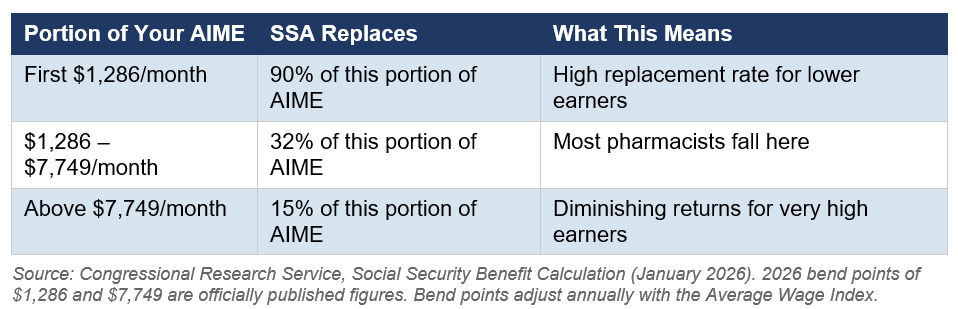
The formula is deliberately progressive — lower earners get back a higher percentage of their pre-retirement earnings from Social Security than higher earners do. For a pharmacist earning $130,000 to $150,000 annually, most of your AIME will fall in the middle bracket, where Social Security replaces 32% of average monthly earnings within that portion of the formula. That’s a meaningful benefit in raw dollars, but a lower replacement rate than lower-income workers receive.
The taxable maximum in 2026 is $184,500. Earnings above that threshold are not subject to Social Security payroll tax and are not counted in your benefit calculation. For most pharmacists, this is not a limiting factor — but it is relevant for those in high-earning specialties or dual-income households.
What This Looks Like in Practice
Here’s a simplified example. Suppose a pharmacist has an AIME of $9,000 per month — a plausible figure for someone who earned $65,000 early in their career in the 1990s (which indexes significantly upward) and progressed to $130,000–$150,000 over a 35-year career:
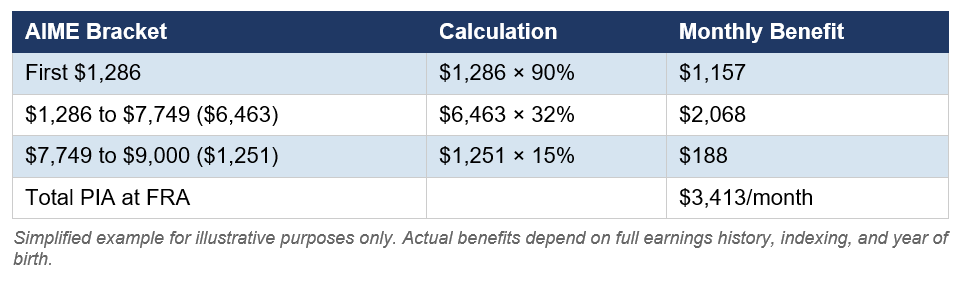
That $3,413 per month is your Primary Insurance Amount (PIA) — what you’d receive at your Full Retirement Age. Claim at 62 and it drops to around $2,389. Wait until 70 and it rises to around $4,232. The base benefit matters because every adjustment — early or late — is calculated from it.
Notice that $1,251 of this pharmacist’s AIME falls above the second bend point, where Social Security replaces only 15 cents per dollar. That’s a reminder that high earners get a smaller percentage of their income replaced — which is why other retirement assets matter so much alongside Social Security.
Why Your Earnings Record Deserves a Second Look
The Social Security Administration maintains an earnings record for every worker. It’s the foundation of your benefit calculation — and occasional reporting errors can affect benefits.
Common issues include missing years of earnings, income incorrectly reported by an employer, or earnings from early jobs that didn’t make it into the system properly. Each error that goes uncorrected can reduce your benefit permanently.
The SSA recommends reviewing your earnings record every few years, not just at retirement. If you find a discrepancy, it can be corrected — but the process is easier when the records from the relevant years are still accessible. Old W-2s, tax returns, and pay stubs are worth keeping for this reason.
Two Things Worth Knowing for High Earners
1. Social Security replaces less of your income proportionally.
Because of the progressive bend point structure, higher earners receive a smaller percentage of their pre-retirement income from Social Security than lower earners do. For a pharmacist earning $140,000 a year, Social Security might replace 25–35% of pre-retirement income. That’s a meaningful check — but it underscores why 401(k) balances, IRAs, and other retirement assets matter so much.
2. Zero years are among the most costly and overlooked issues.
If your career includes years of zero or near-zero covered earnings — from school, a career gap, or work in a non-covered position — those years drag down your AIME. Working longer, even in a reduced capacity, can increase your benefit in a way that’s often underappreciated.
Your One Action Step This Week
Log in to your “my Social Security” account at ssa.gov/myaccount and pull up your earnings record. Go through it year by year and confirm that your reported earnings match what you actually earned. If you find a discrepancy — especially from early in your career — contact the SSA to start a correction. It takes a few minutes and could affect your benefit.
If you’d like to understand how your specific earnings history translates into a projected benefit — and how different retirement dates might affect that number — that’s exactly the kind of conversation we have with clients. The SSA statement is the starting point; knowing what to do with it is the next step.
Sources
Social Security Administration — Retirement Benefit Calculation Examples
Congressional Research Service — Social Security: Benefit Calculation (2026)
The Motley Fool — Social Security Bend Points: What Are They? (2026)
Bipartisan Policy Center — The Social Security Benefit Formula, Explained
This article is for educational purposes only and does not constitute personalized financial, tax, or legal advice. Social Security rules are complex and individual circumstances vary. Consult a qualified financial advisor and tax professional before making retirement decisions. Adam Conway is a Registered Principal. Securities offered through Cambridge Investment Research, Inc., a Broker/Dealer, Member FINRA/SIPC. Investment Advisor Representative, Cambridge Investment Research Advisors, Inc., a Registered Investment Advisor. Cambridge and Conway Financial are not affiliated.
Share our Newsletter!
Forward to Colleagues: Help grow our community of financially-savvy pharmacists