
– PHARMACIST FINANCE WEEKLY –
PHARMACIST
FINANCE
WEEKLY
The Essential Newsletter for Pharmacy Professionals|Your weekly dose of business insights, market intelligence, and career opportunities
Issue #8 | WEEK OF AUGUST 4, 2026
Social Security Taxation: The Threshold Most Pharmacists Cross
85% is not a tax rate. It’s the maximum taxable portion of your benefit — and for most retiring pharmacists, reaching it is nearly inevitable
Sources: IRS Publication 915 • Kiplinger • SmartAsset • SSA.gov
The Most Common Misunderstanding About Social Security Taxes
When people hear that up to 85% of their Social Security benefits could be taxable, many assume that means they’re paying an 85% tax rate on their benefits. That is not what it means — and the difference matters.
Here’s the accurate framing: depending on your income, between 0% and 85% of your Social Security benefit may be included in your taxable income. That taxable portion then gets taxed at your ordinary income tax rate — whatever bracket you’re in — just like any other income. The 85% is a ceiling on how much of your benefit enters the tax calculation, not the rate at which it’s taxed.
For most retiring pharmacists, the more practical question isn’t whether their Social Security benefits will be taxed. It’s how much will be taxed — and what, if anything, can be done about it.
How the IRS Calculates It: Combined Income
The IRS uses a specific formula to determine how much of your Social Security benefit is subject to tax. The key number is called your combined income, sometimes referred to as provisional income:
Combined Income =
Adjusted Gross Income (AGI) + Tax-Exempt Interest + 50% of Your Social Security Benefits
That combined income figure is then compared against fixed thresholds to determine what portion of your benefits becomes taxable. These thresholds have not been adjusted for inflation since 1993, which is one reason more retirees find themselves above them every year — especially as annual cost-of-living adjustments increase benefit amounts and push combined income higher over time.
The Three Tiers
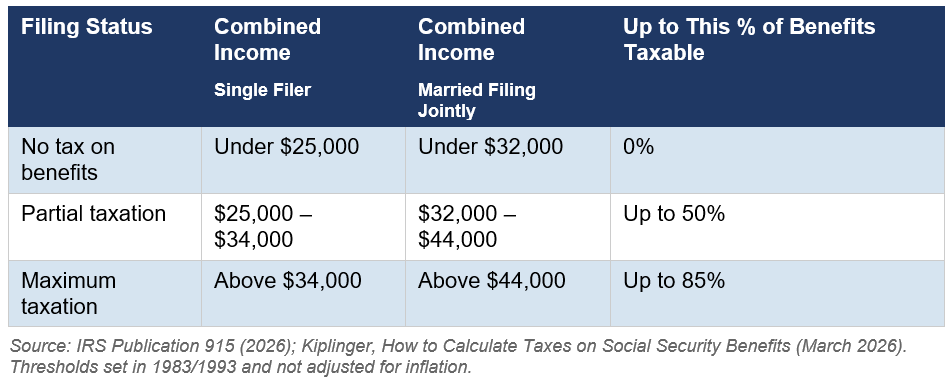
The important word in the table is “up to.” These are ceilings, not flat rates. The actual taxable portion is calculated through an IRS worksheet that phases in gradually rather than jumping all at once. The result can be anywhere from 0% to 85% depending on exactly where your combined income lands.
What catches many retirees off guard is how aggressively the phase-in works in practice. Financial planners sometimes call this the “Tax Torpedo.” When your combined income falls between the two tiers, each additional dollar of income not only gets taxed as ordinary income — it also causes more of your Social Security benefit to become taxable at the same time. The effective marginal tax rate on that additional dollar can be significantly higher than your stated bracket suggests. This multiplier effect is one of the most important reasons why the sequence and source of retirement income withdrawals matters so much in the years around when you claim Social Security.
Why Most Pharmacists Hit the 85% Tier
The thresholds for maximum taxation — $34,000 for single filers and $44,000 for married couples — were set in 1993 and have never been adjusted for inflation. A married couple needed to have a fairly comfortable income in 1993 to exceed $44,000 in combined income. Today, that number is crossed by a wide range of middle-income retirees — and a large percentage of retiring pharmacists.
Here’s why: the combined income formula includes 50% of Social Security benefits as part of the calculation before a single dollar of other income is added. A married pharmacist couple with a combined Social Security benefit of $60,000 per year already contributes $30,000 toward their combined income threshold from Social Security alone. Add any 401(k) withdrawals, pension income, investment distributions, or part-time work, and the $44,000 threshold is crossed almost immediately.
Here’s a simplified example:
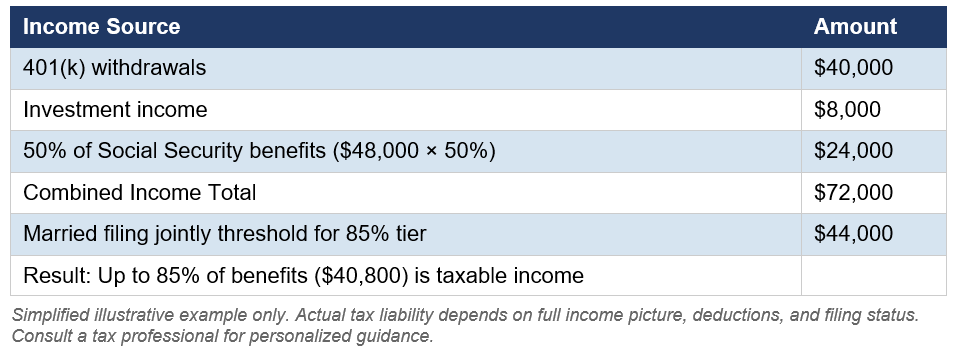
In this example the couple isn’t wealthy by most measures — but 85% of their Social Security benefit is taxable. That means up to $40,800 becomes part of their federally taxable income calculation, taxed at their ordinary income rate. At a marginal federal rate of 22%, that could translate to roughly $8,976 of additional federal income tax attributable to the taxable portion of their Social Security benefits.
The Hidden Trap: Tax-Exempt Interest Still Counts
One of the most frequently overlooked aspects of the combined income formula is that tax-exempt interest — such as income from municipal bonds — is included in the calculation even though it is not subject to income tax.
In other words, a retiree who holds municipal bonds to avoid income tax may still find that the interest from those bonds increases their combined income, which in turn increases the taxable portion of their Social Security benefit. The tax-exempt interest escapes income tax directly, but it can indirectly cause more of the Social Security benefit to become taxable.
This is a nuance that catches sophisticated investors off guard. If you hold municipal bonds as part of your retirement income strategy, it’s worth understanding how they interact with the Social Security tax formula before assuming they are fully “tax-free” in retirement.
What Can Be Done: Three Planning Strategies
1. Roth conversions before claiming Social Security.
Traditional IRA and 401(k) withdrawals count toward AGI and therefore toward combined income. Roth IRA withdrawals do not. The window between retirement and when you begin claiming Social Security — often ages 62 to 70 — can be a valuable opportunity to convert traditional retirement assets to Roth accounts. Doing so now reduces future required minimum distributions and future combined income, potentially keeping more of your Social Security benefit out of the taxable tier.
2. Qualified Charitable Distributions (QCDs).
If you are age 70½ or older and charitably inclined, a QCD allows you to donate up to the annual IRS limit (indexed for inflation) directly from your IRA to a qualifying charity. The distribution satisfies your required minimum distribution but does not count as taxable income — so it does not increase your AGI or your combined income. For retirees near the threshold, this can be a meaningful tool for managing Social Security taxation.
3. Manage withdrawal timing and sequencing.
Because combined income is calculated annually, the timing and source of your withdrawals matters each year. Drawing from Roth accounts in higher-income years, spacing out IRA withdrawals, and being intentional about realizing capital gains can all affect how much of your Social Security benefit ends up in the taxable tier in any given year.
A Note on the 2026 Senior Bonus Deduction
New legislation in 2026 introduced a temporary senior bonus deduction of up to $6,000 per person ($12,000 for married couples filing jointly) for filers age 65 and older, available through 2028. The deduction may reduce overall federal taxable income for some retirees, though retirees should confirm with a tax professional whether it affects the combined income calculation used to determine Social Security taxation.
There is an important caveat for higher-income retirees: the deduction phases out based on Modified Adjusted Gross Income (MAGI). It begins phasing out at $75,000 for single filers and $150,000 for married couples filing jointly, at a rate of 6 cents per dollar over the threshold. It is eliminated entirely at $175,000 (single) and $250,000 (joint).
For many retiring pharmacists with significant 401(k) balances, investment income, or pension income, MAGI in retirement may exceed the $150,000 joint threshold — meaning the deduction could be reduced or unavailable entirely. This is worth modeling with your tax professional before counting on the full benefit.
One reassuring fact:
Under current law, at least 15% of Social Security benefits remain federally tax-free regardless of your income level.
Your One Action Step This Week
Pull your most recent tax return and add up your adjusted gross income, any tax-exempt interest, and 50% of any Social Security benefits you received. That number is your combined income. Compare it to the thresholds in the table above. If you’re already in or near the 85% tier — or expect to be when you retire — that’s a conversation worth having with your financial advisor and CPA before you begin distributions or claim Social Security.
Social Security taxation is one of the areas where the interaction between different income sources creates surprising results. A dollar withdrawn from an IRA can create a ripple effect: not only is the withdrawal itself taxable, it can also cause a larger portion of your Social Security benefit to become taxable at the same time. That multiplier effect is exactly why coordinated retirement income planning matters, and why getting the sequencing right in the years before and after you claim can make a real difference.
A Note on State Taxes
Federal taxation is only part of the picture. As of 2026, eight states still tax Social Security benefits to some degree: Colorado, Connecticut, Minnesota, Montana, New Mexico, Rhode Island, Utah, and Vermont. West Virginia completed its phase-out this year and no longer taxes benefits. The remaining 42 states — including Ohio — do not tax Social Security at the state level.
If you are planning to stay in Ohio through retirement, state-level Social Security taxation is not a concern. If you are considering relocation, the state tax treatment of benefits is worth factoring into the comparison alongside property taxes, cost of living, and overall retirement income tax policy.
Sources
IRS — Publication 915: Social Security and Equivalent Railroad Retirement Benefits (2026)
Kiplinger — How to Calculate Taxes on Social Security Benefits (March 2026)
SmartAsset — Is Social Security Income Taxable? (2026 Update)
IRS — One Big Beautiful Bill Act: Tax Deductions for Working Americans and Seniors (2026)
SSA.gov — Benefits Planner: Income Taxes and Your Social Security Benefits
This article is for educational purposes only and does not constitute personalized financial, tax, or legal advice. Tax rules are complex and individual circumstances vary. Consult a qualified financial advisor and tax professional before making retirement income or claiming decisions. Adam Conway is a Registered Principal. Securities offered through Cambridge Investment Research, Inc., a Broker/Dealer, Member FINRA/SIPC. Investment Advisor Representative, Cambridge Investment Research Advisors, Inc., a Registered Investment Advisor. Cambridge and Conway Financial are not affiliated.
Share our Newsletter!
Forward to Colleagues: Help grow our community of financially-savvy pharmacists